

Expectation Propagation for Phase Noise Channels
Beschreibung
Field of Research & Contents of the Paper
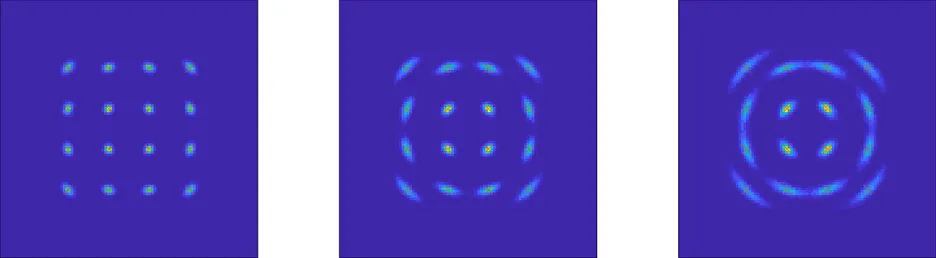
Time-varying phase noise is of interest in many communication scenarios, including high-frequency wireless channels and coherent optical communications.
In [1], the authors introduce an iterative receiver for channels distorted by phase noise. They use strong correlations in the phase noise process for mitigation. A downside is the requirement for pilot insertion, effectively decreasing spectral efficiency.
Expectation propagation (EP) [2][3, Ch. 10, Sec. 10.7] has been recently used to enhance the receiver design, thereby mitigating the need for pilot insertion [4].
The task of this seminar paper is to
- summarize the system model used in [1],[4],
- analyze the approach, benefits, and drawbacks in [1],
- explain the principles of EP, and
- compare how EP modifies the receiver in [4] relative to [1].
A successful submission provides intuition for tasks 1-3 and a thorough analysis of the differences between [1] and [4] for task 4.
[3] C.M. Bishop, "Pattern Recognition and Machine Learning," Springer, 2006.
Organization of the Supervision
- After you have successfully applied for the topic, we will hold a kick-off meeting to discuss all necessary details for the upcoming work. After that, the responsibility for the seminar paper is all on you. You can always contact me, ask questions, and request meetings, and I am happy to assist you along the way. However, I need you to be proactive.
- I can provide comments on your work (e.g., the paper's outline and some paragraphs you have already written) at any time you need them and guide you as you prepare your paper and presentation. Regarding final drafts, I comment on one complete version of your paper. Ideally, this would mean that you do some work (literature research, the paper's outline, the body, the introduction, and the conclusion), and we discuss your results after every step. Ultimately, you provide me with one final draft, and I will comment on it. The draft must be handed in at least 10 days prior to the paper submission deadline. This method is more successful and instructive than writing a paper a few days before the deadline.
- Beware that when I comment on your work, this is not the same as a correction. My comments are suggestions for improving the quality of the work, but I cannot spend the time searching for and correcting every mistake that exists or could be made (this would also not align with the seminar's purpose).
- I expect solid research. There should be two significant references. Those are papers you know in detail and that majorly impact your work. Of course, they are always accompanied by supporting references.
Voraussetzungen
A good knowledge of the Sum-Product algorithm (SPA) and perhaps experience with Approximate Message Passing is helpful. This can be obtained in our lecture, "Machine Learning for Communications." Alternatively, [5] provides a good overview of the SPA.