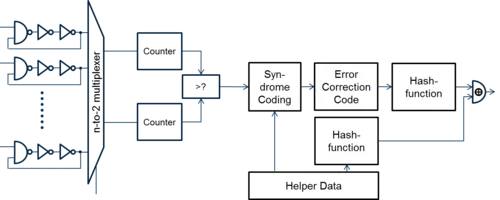
Eine Physical Unlonable Function (PUF) wertet Fertigungsschwankungen in einem Chip aus und erzeugt daraus ein individuelles Signal, das ähnlich wie ein eingescannter Fingerabdruck von Chip zu Chip stark und von Messung zu Messung leicht variiert.
Eine PUF erzeugt also ein verrauschtes Geheimnis reproduzierbar zur Laufzeit. Dieses Geheimnis kann entweder dazu genutzt werden, den Chip zu authentifizieren, oder es steht nach Entfernen des Rauschens als kryptografischer Schlüssel zur Verfügung.
Durch PUFs erhalten auch Systeme ohne sichere Schlüsselspeicher Zugang zu sicheren kryptografischen Schlüsseln.
Forschungsthemen
Neue PUF Primitive und Architekturen insbesonder auch Memristor-basierte PUFs
Strong PUF Security Metrics and Their Resistance to Machine Learning
Stichworte: PUF ML
Beschreibung
In recent years, Physical Unclonable Functions (PUFs) have become a widely studied hardware-based security primitive. Strong PUFs, in particular, are designed to support a large challenge space and are often used in authentication protocols, where a device proves its identity to a remote backend through challenge–response interactions.
Ideally, the mapping from challenges to responses should be highly complex and difficult to predict. However, many underlying PUF constructions, such as arbiter PUFs and loop PUFs, are linear in nature. This makes them vulnerable to machine learning (ML) attacks, which can efficiently learn and reproduce their behavior.
To improve resistance, several approaches have been proposed. These include introducing nonlinearity during the quantization process (e.g., through methods like NMQ) and combining responses from multiple PUF instances using logical operations. While these techniques can make attacks more difficult, their effectiveness is typically evaluated by empirical trials.
This raises an important question: how can the security of strong PUFs against ML attacks be assessed systematically? In practice, security is often judged based on whether existing attacks succeed or fail, but small improvements in models or preprocessing can quickly change these outcomes. This makes it difficult to compare different designs or estimate their robustness.
Your seminar work will explore the following questions: * Is there a way to systematically determine the security of strong pufs against ml attacks? * If not mathematically possible (or not possible for various constructions in a generalized way): Are there practical metrics that give an indication in regard to robustness to ML attacks? * Why are certain techniques — such as challenge transformations — effective in improving ML attacks, and which types of models are most effective in learning PUF behavior?
The following papers will help you as a starting point:
Unified Framework for Qualifying Security Boundary of PUFs Against Machine Learning Attacks - Hongming Fei, Zilong Hu, Prosanta Gope, and Biplab Sikdar - https://arxiv.org/pdf/2601.04697
Strong PUF Security Metrics: Sensitivity of Responses to Single Challenge Bit Flips - Wolfgang Stefani, Fynn Kappelhoff, Martin Gruber, Yu-Neng Wang, - Sara Achour, Debdeep Mukhopadhyay, and Ulrich Rührmair - https://eprint.iacr.org/2024/378.pdf
Betreuer:
Tim Music
Aktuelle Projekte in diesem Bereich
VE-FIDES (Knowhow-Schutz und Identifizierbarkeit von Elektronikkomponenten für vertrauenswürdige Produktionsketten) Unser Beitrag: Verwendung von PUFs zur Absicherung der Lieferkette. [Link zum Projekt]
APRIORI (Resilienz gegen Fehlerinjektionsangriffe für verbesserten Datenschutz von IoT-Endgeräten): Unser Beitrag: Fehlerangriffe auf PUFs und Schutzmechanismen; Projektleitung [Link zum Projekt]
6G Zukunftslabor Bayern – 6G Future Lab Bavaria: Verwendung von PUFs in 6G Netzwerken. [Link zum Projekt]
Ausgewählte Veröffentlichungen
Lars Tebelmann, Ulrich Kühne, Jean-Luc Danger, and Michael Pehl, Analysis and Protection of the Two-Metric Helper Data Scheme, International Workshop on Constructive Side-Channel Analysis and Secure Design. Springer, Cham, 2021. [Download from eprint]
Emanuele Strieder, Christoph Frisch, and Michael Pehl, Machine Learning of Physical Unclonable Functions using Helper Data: Revealing a Pitfall in the Fuzzy Commitment Scheme, IACR Transactions on Cryptographic Hardware and Embedded Systems, 2021(2), 1-36. https://doi.org/10.46586/tches.v2021.i2.1-36i
Lars Tebelmann, Jean-Luc Danger, and Michael Pehl. Self-secured PUF: protecting the loop PUF by masking, International Workshop on Constructive Side-Channel Analysis and Secure Design. Springer, Cham, 2020. [Download from eprint]
Lars Tebelmann, Michael Pehl, and Vincent Immler. Side-channel analysis of the TERO PUF, International Workshop on Constructive Side-Channel Analysis and Secure Design. Springer, Cham, 2019. [Download from eprint]
Florian Wilde, Berndt Gammel, and Michael Pehl, Spatial Correlation Analysis on Physical Unclonable Functions, IEEE Transactions on Information Forensics and Security (Volume: 13 Issue: 6), 2018, pages: 1468-1480; Tool published with it
Lars Tebelmann, Michael Pehl, and Georg Sigl, EM side-channel analysis of BCH-based error correction for PUF-based key generation, Proceedings of the 2017 Workshop on Attacks and Solutions in Hardware Security. 2017.
Michael Pehl, Matthias Hiller, and Georg Sigl, Secret Key Generation for Physical Unclonable Functions – Secret Key Generation and Authentication, In: Information Theoretic Security and Privacy of Information Systems, Cambridge, 2017
Florian Wilde, Large Scale Characterization of SRAM on Infineon XMC Microcontrollers as PUF. 4th Workshop on Cryptography and Security in Computing Systems (CS2 2017) HIPEAC17 , 2017 Public PUF dataset published with it
Matthias Hiller, Meng-Day (Mandel) Yu, and Sigl, Georg, Cherry-Picking Reliable PUF Bits with Differential Sequence Coding, IEEE Transactions on Information Forensics and Security (Volume: 11 Issue: 9), 2016, pages: 2065-2076
Matthias Hiller, Meng-Day (Mandel) Yu, and Michael Pehl, Systematic Low Leakage Coding for Physical Unclonable Functions, ACM Symposium on Information, Computer and Communications Security (ASIACCS), 2015
Florian Wilde, Matthias Hiller, and Michael Pehl, Statistic-based security analysis of ring oscillator PUFs, 2014 International Symposium on Integrated Circuits (ISIC). IEEE, 2014.
Matthias Hiller, Dominik Merli, Frederic Stumpf, and Georg Sigl, Complementary IBS: Application Specific Error Correction for PUFs, IEEE International Symposium on Hardware-Oriented Security and Trust (HOST), pp. 1-6, June 2012.