
February 09-13, 2026

Registration for the Winter School is closed!
Advancing Marine Robotics for a Cleaner Ocean
About the Winter School
The winter school aims to bring together researchers and practitioners from maritime robotics, control, perception, and environmental engineering to tackle marine debris remediation as a real-world autonomy problem. Building on the latest SeaClear2.0 latest advancements, the program focuses on the unsolved technical constraints that dominate marine deployments: vision in degraded conditions (low light, turbidity, domain shift), grasping and manipulation of unstructured debris, robust planning and control under uncertainty, and hard hardware limits in communication, compute, and energy.
We will highlight key challenges, current developments, and results from real-world trials focused on identifying and collecting litter from the seabed under varying environmental conditions.
The format combines lectures and tutorials with short participant introductions (2-minute pitches) to encourage cross-disciplinary exchange. The goal is to connect real field needs (site conditions, operational constraints) with robotics task formulations that can hold up in real deployments, and to highlight research questions that matter in practice.
Key Focus Areas
- Maritime Robotics and Control
- Underwater robotic systems end-to-end: from hardware design to software + onboard autonomy
- Planning and control under environmental uncertainty and inter-vehicle coupling
- Manipulation under uncertainty: compliant interaction, grasp selection, perception-driven retrieval
- Autonomy under constraints: limited communication / compute / energy budgets
- Perception in degraded conditions: robust ML for low light/turbidity, domain shift across sites, scarce datasets
- Multi-robot operations: coordinating UUV/USV/ROV teams for monitoring and intervention
- Real-world deployment challenges: lessons learned from field deployment (what fails, what works), and the research-to-deployment gap
- Underwater robotic systems end-to-end: from hardware design to software + onboard autonomy
- Environmental Engineering
- Marine debris: a large-scale problem with much of it out of sight (e.g., seabed) and hard to address with manual operations alone
- Scalable prevention & remediation: how autonomous systems can complement (and reduce reliance on) human-intensive monitoring and cleanup
Make data usable: practical monitoring/assessment for simple metrics, site prioritization, and impact reporting after interventions
Distinguished speakers
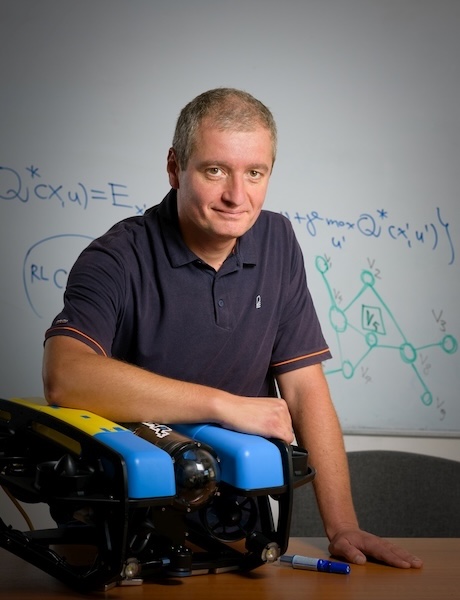


Click on the pictures for the speaker biography.
The winter school will take place in Munich, Germany, a vibrant city known for its excellent academic institutions and rich cultural heritage. Specific venue details will be provided to accepted participants. Munich offers excellent public transportation connections and a wide range of accommodation options.
Information about recommended hotels and accommodation options near the venue will be shared with accepted participants. We are currently compiling a list of convenient options at various price points.
Registration Information
Registration for the Winter School is closed!
TARGET GROUP
- Late-stage master students
- PhD students
- Post-doctoral researchers
Lunch and coffee are provided during lecture days. As part of the winter school, we will also have a group dinner and a tour to Deutsches Museum free of charge. Participants are responsible for their own stay, travel, individual transportation, insurance or any other costs.
CAPACITY
- Maximum 40 participants
- First come, first served with an accepted application
Agenda
Monday 09.02.
| Start | End | Activity |
|---|---|---|
| 15:30 | Meeting Location (Front of Science Congress Center) | |
| 16:00 | 18:00 | Campus tour at the Munich Institute of Robotics and Machine Intelligence (TUM MIRMI) Carl-Zeiss-Str. 8, 85748 Garching b. München |
Tuesday 10.02.
| Start | End | Activity |
|---|---|---|
| 08:30 | 10:00 | Opening & Lecture 1: Stefan Sosnowski [TUM], Optimal control for autonomous collection |
| 10:00 | 10:30 | Coffee break |
| 10:30 | 12:00 | Lecture 2: N. Hoischen, T.-Y. Huang, N. Aoki [TUM], Tutorial: Optimal thrust allocation and grasping strategies |
| 12:00 | 12:30 | Attendees 2min intro pitch |
| 12:30 | 14:00 | Lunch break |
| 14:00 | 15:30 | Lecture 3: Lucian Busoniu [UTC], Optimization-based robotic search |
| 15:30 | 16:00 | Coffee break |
| 16:00 | 17:30 | Lecture 4: Marija Popovich [TUD], Active Sensing for Environmental Monitoring |
Wednesday 11.02.
| Start | End | Activity |
|---|---|---|
| 08:30 | 10:00 | Lecture 5: Kaya ter Burg [TUD], Detection, identification and collection of underwater litter with autonomous robots |
| 10:00 | 10:30 | Coffee break |
| 10:30 | 12:00 | Lecture 6: Scarlett Raine [QUT], Underwater Computer Vision for Ecosystem Monitoring and Reef Restoration: Real-World Challenges and Label Scarcity |
| 12:00 | 12:30 | Lecture 7: Gerard Ciurana [TEC], From lab to market |
| 12:30 | 14:00 | Lunch break |
| 14:00 | 16:00 | Group tour: Deutsches Museum |
| 16:00 | 19:00 | Free time downtown Munich |
| 19:00 | 22:00 | Dinner at Augustiner Klosterwirt |
Thursday 12.02.
| Start | End | Activity |
|---|---|---|
| 08:30 | 10:00 | Lecture 8: Nikolas Dahn [DFKI] |
| 10:00 | 10:30 | Coffee break |
| 10:30 | 12:00 | Lecture 9: Ivana Palunko [UNIDU], Coordinated control and sensing in marine environments with UAVs |
| 12:00 | 12:30 | Attendees 2min intro pitch |
| 12:30 | 14:00 | Lunch break |
| 14:00 | 15:30 | Lecture 10: Domagoj Tolic [RIT Croatia], Intermittent Information in Engineering |
| 15:30 | 16:00 | Coffee break |
| 16:00 | 17:30 | Lecture 11: Daniel-Andre Dücker [TUM], Let's shrink it: Underwater Robotics in the Age of Drones |
Venue
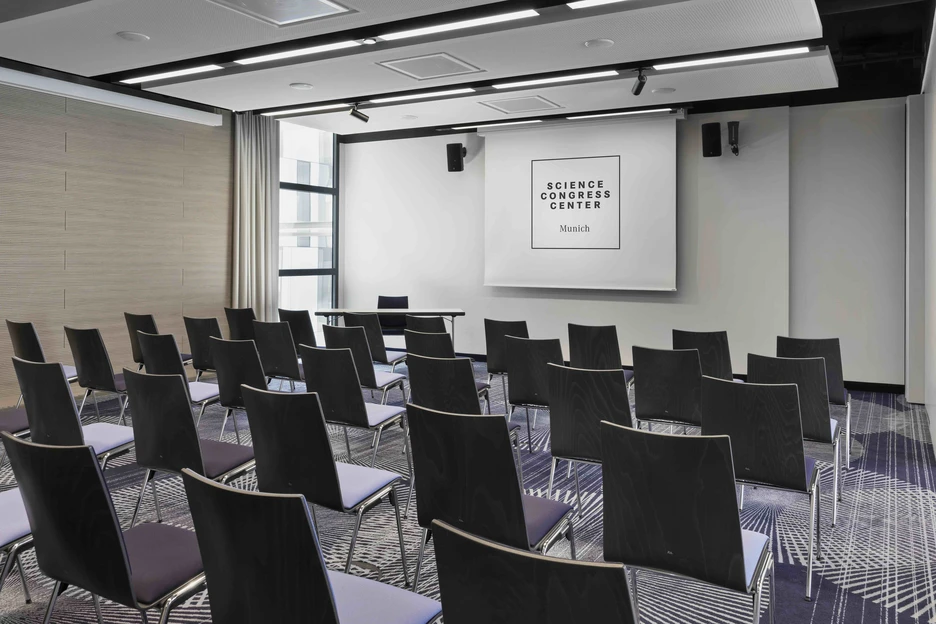
The lectures and tutorials will take place at the Science Congress Center Munich on the Galileo Campus in Garching.
📍Address:
Walther-von-Dyck-Straße 10
85748 Garching bei München
How to get there: https://www.scc-munich.com/en/for-visitors
On campus and around the SCC Munich: https://www.scc-munich.com/en/environment
- Arriving from Munich Airport: Take the S1 train toward Munich to Neufahrn, then take Bus 690 to Garching (45min €8.60)
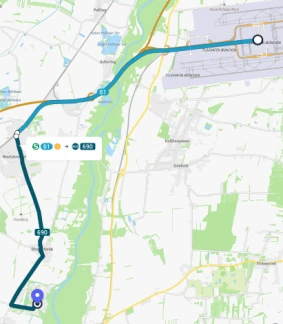
- To get from the city center (Marienplatz) to the winter school location (Garching, Forschungszentrum) and back, use the subway U6. (45 min, Daily Ticket €12.9)

- You can buy all tickets online or from the Ticket machines available everywhere at the train, underground, and bus stations.
- Or you can reach us by Taxi ( From/To Munich Airport 17min, ≈ €40).