
Spatial Human-Robot Interaction
Robots operating in human environments should be able to understand and predict the motion and activity of the nearby people in order to operate safely and efficiently. To achieve the challenging goal of seamless and social navigation, robots require methods for people detection and tracking, semantic and dynamic environment interpretation, activity recognition and prediction, gaze tracking to understand the attention, distraction and social relations of the nearby people. Spatial Human-Robot Interaction (sHRI) studies the interaction of the robot with people in their complex, dynamic environment.
Curious to get a overview of our sHRI research? Check out the recent talk by Andrey Rudenko: https://www.youtube.com/watch?v=OJSJaZVlXCw

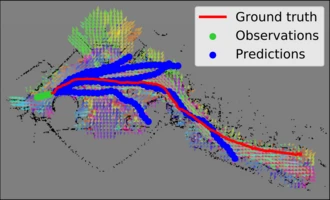
Human motion prediction
We develop methods to predict trajectories and full-body poses of people

Spatial and semantic 3D gaze tracking
Our gaze tracking center provides accurate 3D gaze measurements for navigating and interacting people

Novel communication interfaces
We enable service and industrial robots to communicate and interact with their users

Human motion datasets
We collect large-scale, diverse and accurate human motion and interaction data

Maps of Dynamics
We provide methods for building generalized representations of dynamics in an environment
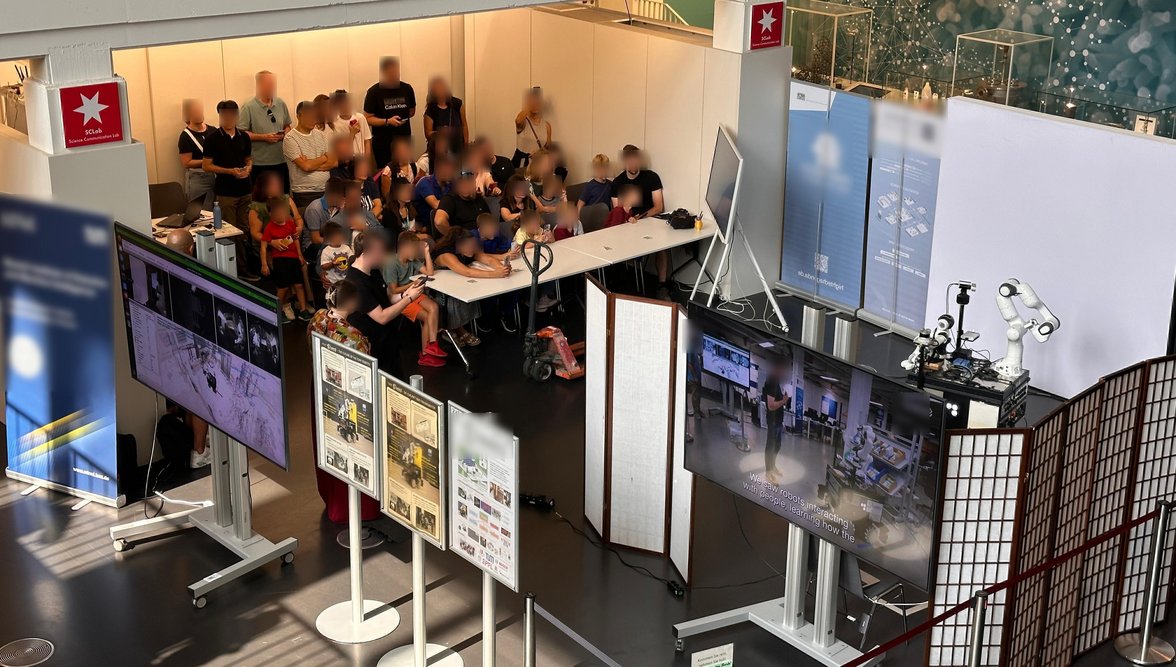
Large-scale user studies
We implement large-scale user studies of robot communication and interaction

Our concept includes building comprehensive models for the Human, the Robot and the Environment.
- The Human Model includes pose, activity and gaze tracking, motion prediction for safe interaction, but also advanced methods such as engagement prediction.
- The Robot Model handles efficient path planning in complex human environments, social navigation, legible movement and intent communication.
- The Environment Model provides the maps of generalized dynamics, affordances and semantic description of the human environment.
Together, these methods permeate the robot control pipeline, from mapping to interaction, making the robot better more human-aware on all levels.
We develop methods to predict the trajectories, 3D full-body poses and interactions of the nearby people.

We provide high-quality motion capture ground truth of human motion during navigation, various activities and interaction with mobile robots.
More details at: http://thor.oru.se


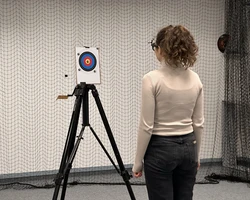
Our setup combines motion capture and gaze tracking glasses to get accurate ground truth in navigation and interaction between people and robots
We are able to measure reaction time, attention areas and distraction
To describe the attention and semantically-meaningful areas in the environment, we build consistent 3D gaze point clouds of the navigating and interacting people in our recordings

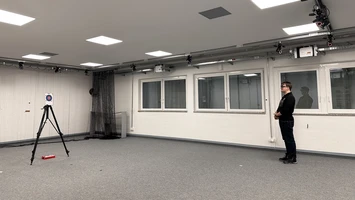
The vision of the functional spatial interaction is to allow the robot actively support the user’s activity in an open-world 3D environment
Our proposed framework combines speech and gaze input from the user with the on-board sensor inputs of the robot to enable intelligent reasoning about the user’s activity and the state of the environment


sHRI Team

Dr. Andrey Rudenko, Team lead

Tim Schreiter, PhD candidate, topic “Design and validation of multimodal state and intent communication for mobile robots”

Jens V. Rüppel, PhD candidate, topic “Multimodal voice and gaze-informed interaction methods for service robots”