
Open PhD Positions
We are an interdisciplinary team at the Chair of Safety, Performance and Reliability for Learning Systems, and we are looking for three exceptional PhD candidates to join our team. The PhD positions will be full-time (100%, TV-L E13). We are committed to fostering a diverse and inclusive research environment, and we strongly encourage candidates from underrepresented groups to apply. The review process is on a rolling basis. Please refer to the "Application Procedure" section for details on how to apply (application form).
External Graduate Programs
You can join us through various external graduate programs that we are a member of:
- Konrad Zuse School of Excellence in Reliable AI (relAI): https://zuseschoolrelai.de/application/
- Munich Center for Machine Learning (MCML): https://mcml.ai/opportunities/for-phd-applicants/
- DFG Research Training Group METEOR (RTG METEOR): https://rtg-meteor.de/
- Research Training Group ConVeY: https://convey.in.tum.de/
If you plan to apply, it makes sense to reach out to us to discuss possible research directions and get help in the application process.
Current PhD Openings

Position Posted on 15.12.2025
Application Deadline 30.01.2026
The next generation of wireless communication, 6G, is envisioned to go far beyond mere data speed, acting as a nervous system for autonomous agents and robotic systems. In particular, the integration of communication, sensing, and control is crucial for "Embodied Intelligence"—robots that interact physically with their environment while relying on high-performance networks. While current systems can handle stable environments, maintaining the performance and safety of mobile robots under fluctuating network conditions or in the presence of hardware uncertainties remains a significant challenge.
This PhD thesis explores the synergy between resilient 6G communication and the control of autonomous robotic systems. As part of the 6G Life project, the core objective is to develop frameworks that allow robots to remain functional and safe even when communication links are degraded or delayed. This involves investigating how semantic and goal-oriented communication can be used to prioritize critical control information, as well as developing learning-based policies that are "communication-aware." Ideally, these systems should adapt their behavior based on the available network resources to ensure task success in interaction-rich scenarios, such as laboratory automation or human-robot collaboration.
By addressing the interplay between communication, resilient networking, and robotic control, your work will contribute to the foundations of the next generation of communication-led robotics. You will work at the cutting edge of 6G research, helping to bridge the gap between theoretical communication bounds and the real-world physical requirements of intelligent, mobile machines.
Position Posted on December 15, 2025
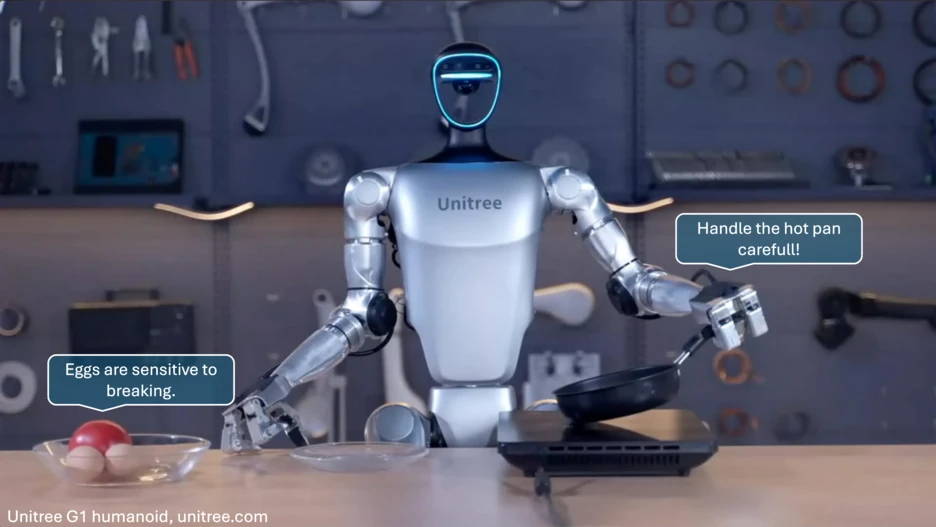
The control of mobile robots has made tremendous progress in recent years, particularly through advancements in machine learning. It is now possible to locomote even complex robots—such as quadrupeds and humanoids—reliably through challenging environments using robust learning algorithms. More interactive tasks, such as object manipulation or human–robot interaction, are also becoming feasible with modern machine learning–based policies. A key aspect of such policies is ensuring safety—whether by preventing damage to delicate objects, such as glassware, or by maintaining safe operation in the presence of humans.
This PhD thesis explores how policies for humanoid robots can be safely deployed in the real world. Its core objective is to develop a framework for successful and safe task completion by humanoid robots in interaction-rich scenarios. Ideally, these policies should learn from mistakes to continuously improve their behavior and interaction with the environment. Addressing these challenges in your PhD work will represent a significant contribution to robotics research.
Position Posted on December 15, 2025
Our actions are guided by what we see and how we understand the world around us. While there have been significant advancements in interpreting images and other sensory data, these breakthroughs have not yet fully translated into robotics. The goal of this work is to harness semantic and contextual understanding to enable robots to make appropriate decisions.
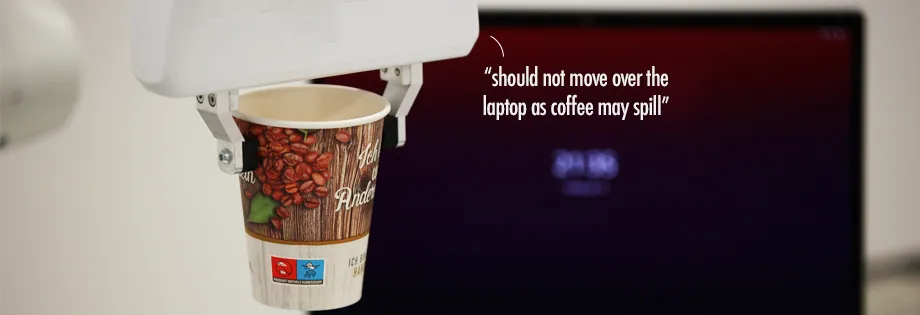
There is a rich body of literature on safe robot decision-making, which focuses on ensuring that robots act within specific state and input constraints. However, when robots operate in real-world environments, these safety constraints need to be addressed through a semantic understanding of the environment. For example, a helper robot should avoid spilling water on electronic devices, bringing flammable products close to heat sources, or putting aluminum foil in the microwave. Recent advancements in machine learning and computer vision have allowed robots to gain this kind of semantic understanding through various sensory modalities, such as vision, language, and audio. However, translating this understanding and "common sense" into actionable constraints for robots is a non-trivial challenge. This thesis aims to bridge the gap between machine intelligence and safe control techniques, enabling robots to make decisions that are semantically informed. It will explore foundational models, language models, and control safety guarantees, with the goal of developing novel algorithms, theoretical advancements with provable guarantees, and real-world demonstrations. Our recent efforts along this research direction are summarized at https://semanticcontrol.com.

Position Posted on December 15, 2025
Aerial swarms have been gaining increasing attention for solving real-world problems due to their agility to navigate through complex environments and their capability to tackle complex tasks and scenarios that are otherwise infeasible for single agents. One of the fundamental challenges in this field is designing efficient planning and control strategies that enable safe and coordinated behaviour among swarm agents. The goal of this PhD is to advance safe multi-agent planning and control algorithms deployed in changing environments with an emphasis on reliable real-world deployment.
Existing literature can be broadly categorized into centralized and distributed approaches. Centralized methodologies are effective in generating optimal smooth coordinating trajectories but often suffer from scalability issues as swarm size increases. Distributed frameworks have emerged to circumvent these challenges. These works have shown improved scalability and efficiency in point-to-point transition tasks. In this thesis, the goal is to extend online distributed swarm trajectory optimization frameworks to enable (i) fast and agile flights and (ii) safe interactive flights. To accomplish this goal, learning-based methods are required to be integrated into the prior model-based frameworks. The developed algorithm is expected to be demonstrated in various applications (e.g., the SwarmGPT project).

Position Posted on December 15, 2025
Human operators are good at performing dexterous tasks, while robots can complete tasks in a consistent and predictable manner. Human-robot teams generally offer improved efficiency and reliability in construction. To best leverage the respective advantages of the human-robot team, it is essential to provide a means for humans and robots to interact in a natural and safe manner. The goal of this PhD work is to develop perception-based methods to seamlessly support human operators in cluttered and dynamic environments for collaborative manipulation. This project will be a part of the Innovation Network on Collaborative Construction, where interdisciplinary collaboration and real-world demonstration are expected.
Complex collaborative construction tasks can be naturally decomposed into smaller tasks with a given order of priority. The priority can be temporal (e.g., picking up an item from point A, and then moving to point B) or contextual (e.g., picking up a rod but giving priority to visually tracking an object of interest). These settings can be naturally represented as hierarchical planning and control problems. There is a rich set of literature on whole-body control approaches for mobile manipulators to excel in single tasks. In this topic, we aim to tackle the difficulties in solving vision-based hierarchical planning and control problems and develop an efficient optimization algorithm specialized for solving hierarchical mobile manipulation tasks in cluttered and dynamic environments. A further step of this project includes developing distributed decision-making approaches to coordinate heterogeneous robot teams, consisting of multiple mobile manipulators and aerial vehicles, for collaborative construction tasks.
Unsolicited Application
At the Learning Systems and Robotics Lab, we pioneer cutting-edge advancements in robot control, machine learning, and multi-robot systems to enable safe, adaptive operations in real-world, uncertain environments—from mobile manipulation to robotic swarms. We are always looking for excellent students with a strong interest in academic research and a top-ranked Master's degree in a relevant field, such as robotics, AI, or computer science. If you are passionate about tackling interdisciplinary challenges in these areas but our current active openings do not fit your particular interests, please submit an unsolicited application.
Requirements
- Top-ranked Master's degree in robotics, computer vision, system control, machine learning, mathematics, or a related field (background in any of the following);
- Being excited to make a real impact with their thesis work in the field of robotics;
- Strong programming skills in C++ and/or Python, as well as experience in implementing robot learning algorithms;
- A strong background in control theory, machine learning, and/or computer vision;
- A proven track record demonstrating strong problem-solving skills and the ability to conduct independent research (e.g., through publications at top venues in robotics, computer vision, machine learning, or a relevant field);
- Excellent communication skills in English and ability to work in a dynamic team environment;
- Previous experience working with real robots is a plus.
If you do not satisfy all requirements but are very interested in the position, please feel free to apply and/or reach out to us for questions.
Application Procedure
Please submit your application package via the following link: http://tiny.cc/lsy-phd-applications. In the application form, you will be asked to submit a package that includes the following documents:
- A personal statement highlighting research interests and relevant experience;
- An academic CV including a full list of publications;
- Transcripts;
- Relevant certificates (e.g., university degrees, additional courses);
- Contact information of three referees;
- Any additional supporting documents you would like to share with us.
If you have any questions regarding the open positions or the application process, please contact us at contact.lsy@xcit.tum.de and ensure that the posting ID (e.g., "TUEILSY-PHD20240919-SSR") is indicated in the subject line.