
- Robust Bayesian Optimisation for Reliable FES Calibration. 2026 48th Annual International Conference of the IEEE Engineering in Medicine and Biology Society (EMBC), IEEE, 2026 more… BibTeX
- Blended Fuzzy Gain-Scheduled Hill-Huxley Model: Torque Prediction in FES-Driven Wrist Contractions. IEEE International Conference on Cyborg and Bionic Systems (CBS), 2026 more… BibTeX
- Hybrid robot & FES rehabilitation after stroke: Short‐term performance, fatigue, and patient experience. Journal of Rehabilitation and Assistive Technologies Engineering 13, 2026 more… BibTeX
- Repetitive Grasping After Stroke Assisted by Functional Electrical Stimulation. Artificial Organs, 2025 more… BibTeX
- Toward Dexterous Hand Functional Movement: Wearable Hybrid Soft Exoglove-FES Study. 2024 10th IEEE RAS/EMBS International Conference for Biomedical Robotics and Biomechatronics (BioRob), 2024 more… BibTeX
- Framework for Learning a Hand Intent Recognition Model from sEMG for FES-Based control. 2024 10th IEEE RAS/EMBS International Conference for Biomedical Robotics and Biomechatronics (BioRob), IEEE, 2024, 1320-1327 more… BibTeX
- Hybrid Functional Electrical Stimulation and Robotic Assistance for Wrist Motion Training after Stroke: Preliminary Results. The International Conference on Rehabilitation Robotics (ICORR) 2023, 2023 more… BibTeX
- Model-Based Shared Control of a Hybrid FES-Exoskeleton: an Application in Participant-Specific Robotic Rehabilitation. 2023 International Conference on Rehabilitation Robotics, ICORR 2023, 2023 more… BibTeX
- Hybrid robotic and electrical stimulation assistance can enhance performance and reduce mental demand. IEEE Transactions on Neural Systems and Rehabilitation Engineering, 2023, 1-1 more… BibTeX
- The Gap in Functional Electrical Stimulation Simulation. 3rd Workshop on Closing the Reality Gap in Sim2Real Transfer for Robotics, 2022 more… BibTeX
- EMG-Based Volitional Torque Estimation in Functional Electrical Stimulation Control. 2022 IEEE-EMBS Conference on Biomedical Engineering and Sciences (IECBES), 2022 more… BibTeX
Personalised Neuromodulation Control
Researcher: Nicolas Kantor Nagel, Hossein Kaviani rad, Satoshi Endo
Motivation
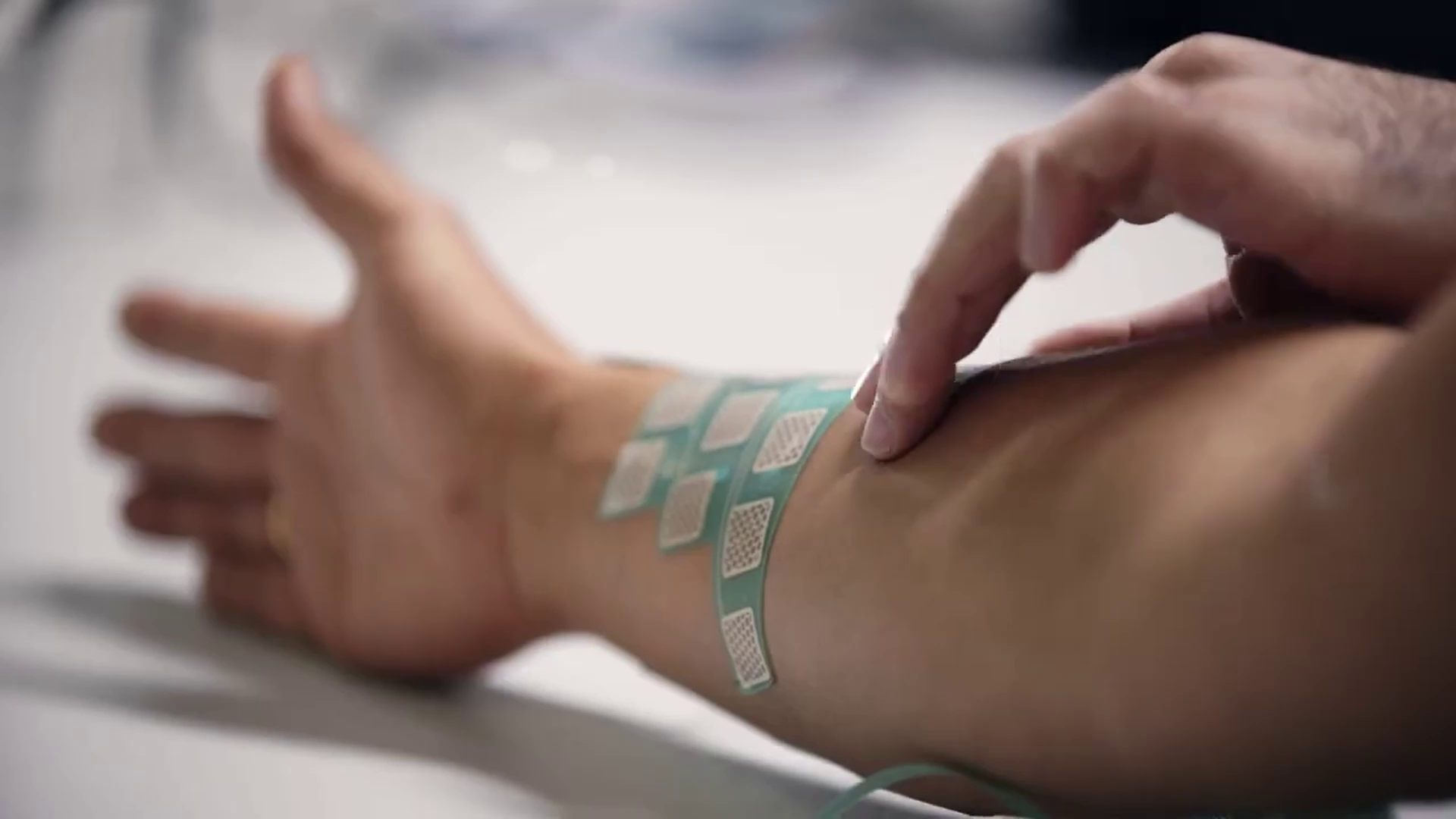
Functional electrical stimulation (FES) can restore or assist movement in individuals with neurological impairments such as stroke, spinal cord injury, or neuromuscular disease by activating paralysed or weakened muscles. Beyond assisting movement execution, FES engages the neuromuscular system directly, providing strong sensory feedback to the central nervous system and promoting neuroplasticity.
The challenge lies in controlling FES effectively. The neuromuscular response to stimulation is non‑linear, noisy, and time‑varying, influenced by factors such as electrode placement, muscle fatigue, changing recruitment patterns, and skin–electrode interface conditions. Excessive stimulation can cause discomfort, fatigue, and reduced engagement, while insufficient stimulation fails to achieve the intended movement. Furthermore, voluntary muscle activity and stimulation‑evoked responses overlap in surface EMG signals, complicating both intent estimation and feedback control.
Research questions
- How can FES‑evoked muscle contractions be modelled in a way that captures non‑linear, time‑varying, and user‑specific response characteristics?
- How can voluntary intent be estimated from EMG even when stimulation artefacts and evoked potentials are present?
- How can stimulation intensity and timing be adapted in real time to maximise functional movement while avoiding over‑stimulation or fatigue?
- How can uncertainty in stimulation response be quantified and incorporated into safe, robust control strategies?
Approach
We are developing adaptive, EMG‑informed control frameworks for FES that combine:
- Robust EMG processing to separate voluntary signals from stimulation artefacts and evoked potentials in real time.
- Probabilistic, user‑specific models of muscle activation that capture the time‑varying nature of stimulation response and adapt continuously during use.
- Uncertainty‑aware control that adjusts stimulation parameters dynamically based on confidence in predicted outcomes, ensuring safety and reliability.
- Personalised calibration that uses short measurement sessions to initialise the model and refine parameters as the system interacts with the user.
By closing the loop between intent estimation, stimulation delivery, and real‑time monitoring of response, the system can provide precisely the right stimulation at the right time. In clinical populations such as stroke survivors, this allows FES to be delivered in synchrony with voluntary effort, reinforcing motor pathways and promoting recovery rather than replacing muscle activity.
Key results and achievements
- Developed robust EMG processing pipelines capable of operating during concurrent stimulation and voluntary movement.
- Designed adaptive stimulation controllers that account for fatigue and recruitment changes, maintaining stable movement quality over time.
- Demonstrated that EMG‑informed FES control improves synchronisation between voluntary intent and stimulation‑induced movement.
- Showed that personalised stimulation strategies can maintain comfort while achieving functional movement goals.
Co-Adaptive Myoelectric Control
Researcher: Hossein Kaviani rad, Satoshi Endo
Motivation
Myoelectric control of dexterous prostheses and robotic hands is fundamentally limited by post-session performance degradation caused by electrode shifts, fatigue, and signal loss. When recalibration is required, current methods adapt deep learning black boxes whose internal states lack physiological meaning. Consequently, neither the user nor the robot can determine if the decoder still captures human intention, and machine adaptation often interferes directly with the user's own motor learning. To solve this, human-robot co-adaptation must take place in a neurophysiologically consistent latent space constrained by motor-unit neural drive, muscle synergies, and musculoskeletal equilibrium.
Research questions
- How can neurophysiologically consistent latent representations be computed within the strict latency budget required for real-time closed-loop control?
- How can adaptation be mathematically divided so the machine compensates for measurement changes while the human learns a stable control mapping?
- How can the latent space remain robust and consistent when specific motor units drop out during a session due to fatigue or electrode shift?
Approach
We are developing a co-adaptive control framework based on high-density EMG (HD-EMG) that combines:
- Model distillation and reduced-order musculoskeletal modelling to separate slow estimation from fast application, ensuring physiological consistency meets real-time latency budgets.
- A formalised two-timescale co-adaptive system that isolates machine adaptation to the observation model (e.g., electrode geometry and channel gains) while providing a stable, physics-based control map for human motor learning.
- Uncertainty-aware neural estimation that detects lost motor units, adjusts precision weights, and propagates uncertainty to act as an online self-assessment of decoder validity.
- Dynamic shared autonomy that uses this uncertainty metric to trigger recalibration or seamlessly shift control authority toward autonomous robotic grasp stabilisation.
By closing the loop between neurophysiological intent estimation, real-time decoding, and robotic actuation, the system dynamically balances human control with autonomous grasp stabilisation. For individuals with upper-limb differences, this ensures the robotic hand functions as a reliable, natural extension of their own motor system. Furthermore, because the latent space is grounded in muscle physiology, this framework can readily integrate secondary applications alongside the prostheses, such as functional electrical stimulation (FES) to reinforce motor pathways during rehabilitation.
Key results and achievements
- Integrated biophysical EMG model, motor-unit decomposition, and real-time decoding to successfully control a physical robotic hand.
- Established that decoders structurally constrained by physical models transfer markedly better across days and subjects compared to purely data-driven models.
- Demonstrated that physically constrained decoders are uniquely capable of developing latent representations that specialise anatomically by finger.
- Framework for Learning a Hand Intent Recognition Model from sEMG for FES-Based control. 2024 10th IEEE RAS/EMBS International Conference for Biomedical Robotics and Biomechatronics (BioRob), IEEE, 2024, 1320-1327 more… BibTeX
- EMG-Based Volitional Torque Estimation in Functional Electrical Stimulation Control. 2022 IEEE-EMBS Conference on Biomedical Engineering and Sciences (IECBES), 2022 more… BibTeX